As an Amazon Associate, we earn from qualifying purchases. Some links on this site are affiliate links at no extra cost to you. Our recommendations are based on thorough research and editorial judgment.

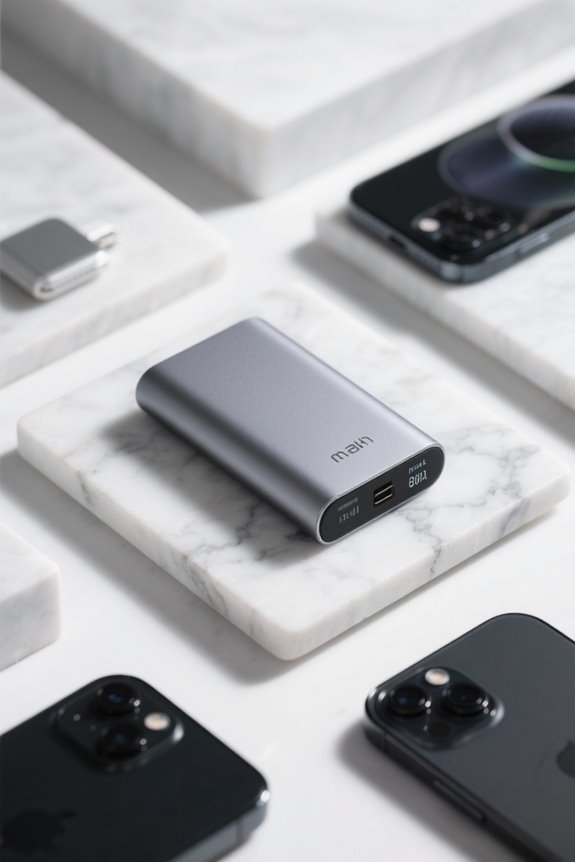
Power Bank Capacity: Understanding Mah Vs Real-World Usage

Power bank capacity is often rated in milliampere-hours (mAh), but this figure can be misleading due to energy losses during charging and voltage conversion. Real-world efficiency typically ranges from 70% to 90%, meaning a 10,000mAh power bank may only deliver about 8,500mAh of usable charge. Additionally, watt-hours (Wh) provide a clearer measure of energy capacity. Understanding these nuances helps users choose the right power bank, which may just be the key to effective device charging efficiency.
Key Takeaways
- mAh indicates battery capacity, but Wh provides a more accurate measure of usable energy due to voltage variations.
- Real-world usable capacity ranges from 70% to 90% of rated capacity due to conversion losses and inefficiencies.
- Energy losses during charging can reach up to 20%, impacting how much energy is effectively usable.
- Environmental factors like temperature can significantly affect charging efficiency and overall performance.
- Regular maintenance, such as calibrating and avoiding overcharging, helps prolong the power bank’s functionality.
What Is Mah and How Is It Measured?
You may be interested



When exploring the world of power banks, understanding mAh, or milliampere-hours, is essential for making informed choices. mAh measures battery capacity, indicating how long a power bank can charge devices. Generally, a higher mAh rating suggests the ability to store more energy, allowing for multiple charges before replenishing the power bank itself. However, the actual usable capacity often falls short due to energy losses during power conversion. This inefficiency can result in less effective charging than advertised. To gain a realistic view, it’s important to account for voltage and convert mAh into watt-hours (Wh) using the formula: (mAh × Voltage) ÷ 1,000. Ignoring this conversion can lead to misleading assumptions about a power bank’s real-world performance. Additionally, safety features in power banks such as overheat protection and intelligent charging management are crucial for ensuring both device safety and optimal performance during usage.
The Importance of Watt Hours (Wh) in Power Banks

Understanding watt hours (Wh) is pivotal for anyone evaluating the capacity and efficiency of power banks. Wh offers a precise measure of total energy capacity, unlike the often misleading milliampere-hours (mAh). For example, a 10,000mAh power bank at 3.7V provides 37Wh, showcasing how voltage impacts actual capacity. Consequently, two power banks with identical mAh ratings may deliver varying energy outputs based on voltage differences. Real-world usage often reveals that these devices operate at about 70-90% efficiency, leading to potential power loss and unmet expectations. By focusing on Wh, users can accurately gauge how much energy they can rely on for their devices during trips, minimizing overdependence on seemingly high mAh figures and improving travel planning. It’s important to consider charging speed and simultaneous charging capabilities when selecting a power bank to ensure it meets your specific device needs effectively.
Understanding Rated Capacity and Its Significance

Rated capacity, which indicates the maximum energy a power bank can store and release, plays a crucial role in determining overall efficiency and usability. This value, expressed in milliampere-hours (mAh) or watt-hours (Wh), represents the ideal power supply under controlled conditions. However, in real-world usage, factors like temperature and discharge rate can reduce usable capacity considerably. Consumers might find that actual performance is only 70-90% of the rated capacity. Energy loss during the charging process—often related to conversion efficiency—further impacts how much usable power is available. Understanding this discrepancy helps users set realistic expectations for their devices. Ultimately, comprehending rated capacity versus usable capacity is essential for effective power bank selection and ideal device performance. When choosing a solar power bank, considering the Ingress Protection (IP) ratings is crucial for ensuring reliability in various environmental conditions.
How Conversion Efficiency Affects Performance

Although many consumers might be drawn to a power bank’s labeled capacity, the actual performance hinges greatly on conversion efficiency. Typically ranging from 80% to 90%, conversion efficiency indicates how effectively a power bank transforms stored energy into usable charge. For instance, a 10,000mAh power bank operating at 85% efficiency delivers only about 8,500mAh of usable capacity. This decrease occurs primarily when the nominal voltage of 3.7V is boosted to 5V—a necessary step for charging devices. Energy loss during conversion often results in heat, influenced by battery quality and circuitry. Understanding conversion efficiency allows users to set realistic expectations for how many times a power bank can fully charge their devices, ensuring more informed purchasing decisions. Many of the best power banks come with built-in cables, enhancing convenience and compatibility with various devices.
Analyzing Actual Capacity vs. Advertised Capacity

Consumers often face a stark contrast between the advertised capacity of power banks and their actual output. Typically stated in milliampere-hours (mAh), this advertised capacity can mislead users. For example, a 10,000mAh power bank may provide only 6,000 to 8,500mAh due to energy losses during charge conversion. The conversion efficiency often ranges from 70-85%, influenced by voltage differences—the internal battery operates at 3.7V while devices usually require 5V. This discrepancy illustrates that high-quality power banks, like those from Veger, generally exhibit lower power loss and better performance. Furthermore, factors such as active device usage and environmental conditions can further diminish the actual capacity, leading to a more compressed total charge cycle than promised. Notably, fast charging capabilities in power banks can greatly enhance user experience by reducing charging times, a crucial feature highlighted in reviews of top models.
The Role of Energy Loss in Power Delivery
When examining power delivery from energy sources like power banks, energy loss plays an essential role in determining overall performance. Energy loss during charging and discharging can reach up to 20%, significantly reducing the usable power a power bank can store. This is largely due to voltage conversion inefficiencies, shifting from a nominal battery voltage of 3.7V to a necessary 5V for devices. High-quality batteries help increase conversion efficiency, often between 80% to 90%. However, real-world performance typically registers as only 60% to 85% of advertised capacity. Understanding these losses is vital for users, as they directly influence the total number of device charges a power bank can deliver, impacting overall user experience and satisfaction. Additionally, safety features like overcharge protection and short-circuit safeguards play an essential role in maintaining device safety and longevity.
Factors Influencing Real-World Performance
While various factors contribute to the actual performance of a power bank, understanding these elements is essential for maximizing its utility. Key influencing factors include conversion efficiency, which typically varies from 70% to 85%. This means the device’s usable capacity can be meaningfully lower than advertised. Additionally, voltage differences result in energy lost during power conversion; for instance, boosting internal voltage (3.7V) to output (5V) incurs losses. Battery age directly influences capacity loss, often reducing output power by 10-30%. Moreover, how many devices are charged simultaneously—and their active use—can strain performance. Finally, environmental conditions, particularly temperature extremes, can accelerate energy loss and damage charging abilities. Choosing a power bank with intelligent protection features can safeguard your devices from overheating and over-voltage issues, thereby enhancing performance and longevity. Consequently, mindful usage can noticeably enhance performance and longevity.
Choosing a Power Bank: Beyond Mah
How does one make an informed decision when choosing a power bank? Start by prioritizing the watt-hour (Wh) rating, as this reflects the total energy capacity better than the milliampere-hour (mAh) value. Pay attention to charging efficiency, typically between 70% and 85%, which means real-world usable energy can fall short of advertised capacity. For instance, a power bank rated at 30Wh might provide only 25Wh during actual use. Additionally, consider the voltage output of the power bank—usually 5V—against your device’s nominal voltage, generally around 3.7V. Once basic energy needs are met, contemplate features like fast charging and portability. Conducting discharge tests can also greatly clarify the actual performance of potential power banks. Considering multiple device charging capabilities is crucial for efficiency, as it enables simultaneous charging of various devices, a common feature in modern power banks.
Safety Considerations When Selecting a Power Bank
What safety aspects should consumers prioritize when selecting a power bank? First, look for certifications like CE, FCC, and RoHS. These labels confirm compliance with safety standards, reducing risks of overheating or battery failure. Avoid unbranded power banks, as they often lack essential safety features, potentially leading to hazards such as swelling or explosions. Additionally, consider the power bank capacity and overall quality; cheaper options may utilize recycled or inferior battery cells, heightening risks during use. Assess the device’s construction, including surge protection, temperature control, and short-circuit prevention. Finally, thoroughly review the warranty—it reflects the manufacturer’s commitment to safety and reliability. A robust warranty suggests confidence in the product’s quality and longevity. Moreover, overcharge protection and temperature controls are critical features that enhance user safety and prevent overheating during prolonged use.
Tips for Maximizing Power Bank Efficiency
To guarantee peak performance, users should prioritize specific strategies that maximize the efficiency of their power banks. Regularly calibrating the device—discharging it completely and then fully charging it—every few months enhances power bank capacity. Store the power bank in a cool, dry environment to minimize self-discharge and preserve its overall effectiveness. Using a higher quality charging cable is also essential; it reduces resistance, enhancing power transfer efficiency. Additionally, users should avoid overcharging by disconnecting once full capacity is reached, as prolonged charging can degrade battery health. Practical discharge tests can help monitor performance and adjust expectations regarding the actual amount of power available, particularly when charging multiple devices, and considering voltage conversions. Adding a power bank with dual band WIFI6 capability can also enhance convenience by allowing seamless connectivity with various devices.
Frequently Asked Questions
Is 20000MAH Better Than 30000MAH Power Bank?
In a capacity comparison, a 20,000mAh power bank may be better for portability, weight differences, and faster charging in specific usage scenarios, while a 30,000mAh bank offers more device compatibility and longer usage time.
Is 10,000 Mah the Same as 100WH?
Is 10,000mAh really equivalent to 100Wh? No, it reflects a capacity conversion that varies by voltage. Charger efficiency and battery longevity affect performance, emphasizing the importance of power bank comparison in specific usage scenarios.
What Is the Actual Capacity of a 20000MAH Power Bank?
The actual capacity of a 20,000mAh power bank typically ranges between 12,000mAh and 16,000mAh. This discrepancy arises from capacity calculation, charging efficiency, discharge rate, and battery lifespan influencing power bank branding perceptions.
Should I Get a 5000 or 10,000 Mah Power Bank?
Choosing a 10,000mAh power bank offers better efficiency, faster charging speed, and broader device compatibility despite a higher price. Portability considerations may favor the 5000mAh option for casual users needing less frequent charging.